







Every modern residential mini-split sold in North America in 2026 uses an inverter compressor. But the distinction between inverter and non-inverter technology explains why mini-splits are dramatically more efficient, quieter, and longer-lasting than older fixed-speed systems — and understanding it helps you avoid accidentally purchasing legacy equipment that will cost significantly more to run. This guide explains the difference clearly.
Compatible with all brands of ACs and Mini-Splits
Automate Climate Management
Control remotely
Reduce Energy Consumption
Monitor bills in realtimeKlima - Smart Home Thermostat for Mini-splits, Air Conditioners and Heatpumps
The Core Difference
| Feature | Non-Inverter (Fixed Speed) | Inverter (Variable Speed) |
|---|---|---|
| Compressor speed | Fixed — full ON or full OFF | Variable — 10% to 130% of rated speed |
| Temperature control | ±3–5°F swings between cycles | ±0.5–1°F continuous precision |
| Electricity use vs equivalent cooling | Baseline | 30–50% less |
| Startup current draw | 5–7× running current each startup | Gradual ramp — no inrush spike |
| Noise during operation | Cycles of full blast and silence | Continuous quiet low-speed operation |
| Compressor lifespan | Shorter — high-stress start/stop cycling | Longer — low-stress continuous operation |
| Equipment cost premium | Lower upfront | Higher upfront; recovers in 2–4 years of electricity savings |
How Inverter Technology Works
An inverter compressor uses a variable-frequency drive (VFD) between the electrical supply and the compressor motor. The VFD changes the frequency of electricity delivered to the motor, which directly changes the motor's speed. At low demand (the room is close to setpoint), the VFD delivers low-frequency power → the compressor runs slowly at 20–30% capacity. At high demand (room far from setpoint), the VFD delivers high-frequency power → the compressor runs at 100%+.
This is why an inverter mini-split uses far less electricity than a fixed-speed system: it only runs as hard as the current demand requires, rather than always running at full power and cycling off when done.
Are Any Non-Inverter Mini-Splits Still Sold?
Very few. In North America, essentially all residential mini-splits sold in 2026 are inverter models. Non-inverter mini-splits still exist in some commercial and light-industrial applications where simpler control circuits are preferred, and in some very low-cost import products. When shopping for a residential mini-split, inverter technology is the standard — any reputable brand's current product line will be inverter-based.
Frequently Asked Questions
My older mini-split cycles on and off frequently — does that mean it's non-inverter?
Not necessarily. Inverter mini-splits can also cycle on and off if they are oversized for the space — reaching setpoint very quickly, shutting down, then restarting as the room warms. Frequent cycling in an inverter system usually indicates oversizing. A non-inverter system cycles continuously regardless of sizing because it has no intermediate speed — it must fully stop when setpoint is reached because it cannot run at lower output.
Related reading:
→ Mini-Split Inverter Compressor: What It Does and Why It Matters
→ SEER vs SEER2: What Changed and Why It Matters
→ Mini-Split Buying Guide 2026: Everything You Need to Know


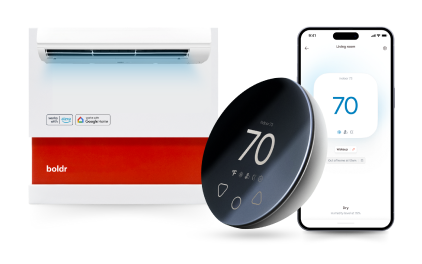
Klima - Smart Home Controller for Mini-splits, Air Conditioners and Heatpumps
Compatible with all brands of ACs and Mini-Splits Automate Climate Management Control remotely Reduce Energy Consumption Monitor bills in realtime
Try NowRecent Articles

Mini-Split Outdoor Unit Clearance 2026 Guide
A mini-split outdoor unit needs air. Lots of it. The condenser pull...
Read More
What Happens if Your Mini-Split Is Too Small?
Most homeowner sizing advice focuses on oversized mini-splits. But ...
Read More
Does a Mini-Split Need a Manual J Load Calculation?
A 500-square-foot room does not automatically need a 12,000 BTU min...
Read More
Signs Your Mini-Split May Have a Refrigerant Leak
A mini-split does not normally “use up” refrigerant the way a car u...
Read More
Mini-Split Minimum Capacity: Why It Matters
When homeowners compare mini-splits, they normally look at the bigg...
Read More