






Defrosting a mini-split means either using the unit's built-in defrost cycle (during heating mode in cold weather) or manually defrosting a frozen indoor coil that has iced up due to restricted airflow or low refrigerant. These are two very different situations — one is normal operation, one indicates a problem. This guide covers both clearly.
Compatible with all brands of ACs and Mini-Splits
Automate Climate Management
Control remotely
Reduce Energy Consumption
Monitor bills in realtimeKlima - Smart Home Thermostat for Mini-splits, Air Conditioners and Heatpumps
Situation 1: Outdoor Unit Defrost During Heating Mode (Normal)
When a mini-split runs in heating mode in cold weather, frost accumulates on the outdoor coil as heat is extracted from the cold air. This is normal and expected. The system automatically runs a defrost cycle every 30–90 minutes to clear this frost:
- The system briefly reverses refrigerant flow to send warm refrigerant to the outdoor coil
- The outdoor fan stops during defrost to prevent cold air from counteracting the warming
- The indoor unit may blow cool or ambient air for 3–10 minutes
- Steam rises from the outdoor unit as the frost melts — this is normal
- Water drips from the outdoor unit — this is the melted frost draining away, completely normal
No action is needed. The system returns to heating automatically when the defrost cycle completes. Do not reset the unit during a defrost cycle.
Situation 2: Manually Defrosting a Frozen Indoor Coil (Indicates a Problem)
If the indoor evaporator coil has frozen in summer cooling mode (or during heating), manual defrosting is needed before you can diagnose and fix the root cause.
Step-by-Step Manual Defrost
Step 1 — Set the unit to FAN ONLY mode. This keeps the fan running to blow warm air over the frozen coil while the compressor is off. Fan-only mode defrosts faster than turning the unit completely off because warm room air is actively circulated over the coil.
Step 2 — If your unit has no fan-only mode, turn it completely off at the remote. The fan will stop, but the ice will still melt naturally over 2–3 hours.
Step 3 — Place towels or a tray below the indoor unit to catch meltwater. A heavily frozen coil can produce a significant amount of water as it thaws.
Step 4 — Wait 2–3 hours. Do not use heat guns, hair dryers, or hot water to accelerate defrosting — rapid temperature changes can damage the delicate aluminium fins on the evaporator coil.
Step 5 — After the coil is fully clear, open the front panel and clean the filter. A dirty filter is the most common cause of coil freezing.
Step 6 — Restart the unit in cooling mode and monitor for 30 minutes. If the coil begins to ice again, the issue is not resolved — low refrigerant or a fan motor problem requires technician attention.
How to Tell If the Coil Is Fully Defrosted
Open the front panel (with the unit off) and visually inspect the evaporator coil (the fin-and-tube heat exchanger behind the filter). The fins should be uniformly silver/grey with no white frost or clear ice visible. Run your hand along the front of the coil — it should feel cold but not icy, and no ice crystals should be visible or felt.
Frequently Asked Questions
My mini-split says "dF" or "DF" on the display — what does that mean?
"dF" or "DF" is the defrost indicator displayed during the automatic outdoor coil defrost cycle in heating mode. It is a status notification, not an error code. The unit is working correctly. Heating will resume automatically in 3–10 minutes when the defrost cycle completes.
How often should a mini-split defrost in winter?
In cold, humid conditions (0°C to −10°C with high relative humidity), a mini-split may run defrost cycles every 30–60 minutes. In very dry cold or milder temperatures, cycles may be less frequent. Defrost frequency is controlled by coil temperature sensors and varies automatically based on conditions. Frequent defrost cycles are not a malfunction — they are the system responding correctly to conditions.
Related reading:
→ Mini-Split Frozen Up in Summer: Why and How to Fix It
→ Mini-Split Ice Buildup: Why It Happens and How to Fix It
→ Mini-Split Not Heating? 8 Common Causes and Fixes


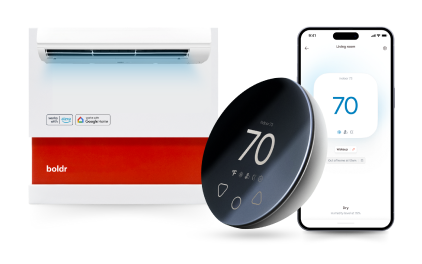
Klima - Smart Home Controller for Mini-splits, Air Conditioners and Heatpumps
Compatible with all brands of ACs and Mini-Splits Automate Climate Management Control remotely Reduce Energy Consumption Monitor bills in realtime
Try NowRecent Articles

Mini-Split Outdoor Unit Clearance 2026 Guide
A mini-split outdoor unit needs air. Lots of it. The condenser pull...
Read More
What Happens if Your Mini-Split Is Too Small?
Most homeowner sizing advice focuses on oversized mini-splits. But ...
Read More
Does a Mini-Split Need a Manual J Load Calculation?
A 500-square-foot room does not automatically need a 12,000 BTU min...
Read More
Signs Your Mini-Split May Have a Refrigerant Leak
A mini-split does not normally “use up” refrigerant the way a car u...
Read More
Mini-Split Minimum Capacity: Why It Matters
When homeowners compare mini-splits, they normally look at the bigg...
Read More