






COP (Coefficient of Performance) is the fundamental efficiency metric for heat pumps — it tells you how many units of heat energy the system delivers for every unit of electrical energy consumed. A COP of 3.0 means 3 watts of heat delivered for every 1 watt of electricity used. Understanding COP helps you compare heat pump efficiency across different conditions and translate efficiency ratings into real operating costs.
Compatible with all brands of ACs and Mini-Splits
Automate Climate Management
Control remotely
Reduce Energy Consumption
Monitor bills in realtimeKlima - Smart Home Thermostat for Mini-splits, Air Conditioners and Heatpumps
What COP Means in Practice
| COP Value | Meaning | Comparison |
|---|---|---|
| 1.0 | 1 unit of heat per 1 unit of electricity — 100% efficient | Electric resistance heating (baseboard, heat strips) |
| 2.0 | 2 units of heat per 1 unit of electricity — 200% | Typical mini-split at 0°F (−18°C) |
| 3.0 | 3 units of heat per 1 unit of electricity — 300% | Good mini-split at 17°F (−8°C) |
| 4.0 | 4 units of heat per 1 unit of electricity — 400% | Premium mini-split at 47°F (8°C) |
How COP Changes with Temperature
COP is not a fixed number — it changes with outdoor temperature. As outdoor temperature drops, the heat pump must work harder to extract heat from colder air, consuming more electricity per unit of heat delivered. This is why mini-split heating bills are higher in January than in October even at the same thermostat setting.
| Outdoor Temperature | Typical COP (Standard Model) | Typical COP (Cold-Climate) |
|---|---|---|
| 47°F / 8°C | 3.5–4.5 | 3.5–4.5 |
| 17°F / −8°C | 2.0–2.5 | 2.5–3.0 |
| −4°F / −20°C | 1.5–2.0 | 2.0–2.5 |
| −13°F / −25°C | May not operate | 1.5–2.0 |
COP vs HSPF2: What's the Difference?
COP is an instantaneous measurement at a specific temperature. HSPF2 (Heating Seasonal Performance Factor) is a seasonal average that accounts for how much time the system operates at each temperature across a representative heating season. HSPF2 is the practical metric for estimating annual heating costs; COP is more useful for understanding performance at a specific temperature point.
The relationship: HSPF2 ÷ 3.412 ≈ average seasonal COP. An HSPF2 of 10 ≈ average COP of 2.93 across the heating season.
Frequently Asked Questions
Can a mini-split really be more than 100% efficient?
Yes — because it is not generating heat, it is moving it. A COP of 3.0 is genuinely 300% efficient in the conventional sense because the heat pump delivers 3 units of thermal energy for every 1 unit of electrical energy consumed. The extra 2 units come from heat extracted from outdoor air — which is freely available. This is not a violation of thermodynamics because the system is functioning as a heat mover, not a heat generator.
What is a good COP for a mini-split?
At the standard rating condition of 47°F (8°C), a COP of 3.5–4.5 is typical for a good modern mini-split. For cold-climate applications, a COP above 2.0 at 5°F (−15°C) is the threshold that makes heat pumps more efficient than electric resistance heating even in very cold weather.
Related reading:
→ Mini-Split HSPF Rating: What It Means for Heating Costs
→ How Efficient Is a Mini-Split in Winter? Real Numbers
→ Mini-Split vs Electric Furnace: Which Heats Better?


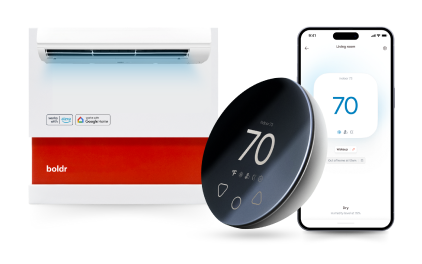
Klima - Smart Home Controller for Mini-splits, Air Conditioners and Heatpumps
Compatible with all brands of ACs and Mini-Splits Automate Climate Management Control remotely Reduce Energy Consumption Monitor bills in realtime
Try NowRecent Articles

Mini-Split Outdoor Unit Clearance 2026 Guide
A mini-split outdoor unit needs air. Lots of it. The condenser pull...
Read More
What Happens if Your Mini-Split Is Too Small?
Most homeowner sizing advice focuses on oversized mini-splits. But ...
Read More
Does a Mini-Split Need a Manual J Load Calculation?
A 500-square-foot room does not automatically need a 12,000 BTU min...
Read More
Signs Your Mini-Split May Have a Refrigerant Leak
A mini-split does not normally “use up” refrigerant the way a car u...
Read More
Mini-Split Minimum Capacity: Why It Matters
When homeowners compare mini-splits, they normally look at the bigg...
Read More