







Inverter technology is the most important engineering advance in modern mini-splits — it is what allows them to run continuously at variable output rather than cycling on and off at full power. Understanding how inverter compressors work explains why mini-splits are 2–3x more efficient than older fixed-speed systems, why they maintain temperature more precisely, and why they last longer under normal operating conditions.
Compatible with all brands of ACs and Mini-Splits
Automate Climate Management
Control remotely
Reduce Energy Consumption
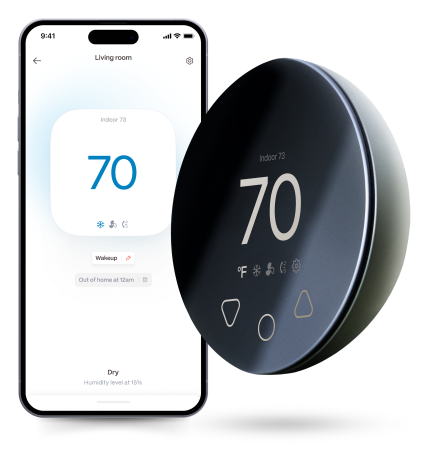
Monitor bills in realtimeKlima - Smart Home Thermostat for Mini-splits, Air Conditioners and Heatpumps
Fixed-Speed vs Inverter: The Core Difference
| Factor | Fixed-Speed Compressor | Inverter Compressor |
|---|---|---|
| How it runs | Full power ON until setpoint, then OFF — repeats | Varies speed continuously — ramps up or down to match demand |
| Temperature stability | Swings ±4–6°F around setpoint between cycles | Maintains within ±0.5–1°F of setpoint continuously |
| Energy efficiency | Wastes energy on startup surge every cycle | No startup surge — runs at exactly the needed output |
| Compressor wear | Higher — repeated start/stop cycles stress components | Lower — continuous low-stress operation |
| Typical SEER2 | 10–14 | 16–42+ |
How an Inverter Compressor Works
A standard compressor motor runs at a fixed speed determined by the electrical frequency (60 Hz in North America = 3,600 RPM). An inverter compressor adds a variable-frequency drive (VFD) between the power supply and the motor — the VFD converts incoming AC power to DC, then generates a new AC output at whatever frequency the controller demands. By varying the output frequency from 20–120 Hz, the compressor speed varies from 1,200–7,200 RPM, delivering anywhere from 20–120% of rated capacity.
This is why a 12,000 BTU mini-split can run at 4,000 BTU on a mild day (just maintaining temperature with a light load) and ramp up to 14,000+ BTU on a very hot day (maximum cooling demand). The same unit serves both extremes efficiently.
Why Inverter Technology Matters for Cold Climates
Cold-climate mini-splits take inverter technology further with flash injection or enhanced vapor injection — additional refrigerant circuit engineering that maintains compressor efficiency at very low suction pressures encountered in extreme cold. Without EVI, a compressor simply can't extract useful heat from −13°F outdoor air. With it, the inverter can still modulate and deliver meaningful heat output at temperatures where traditional heat pumps stop working.
Frequently Asked Questions
Are all mini-splits inverter-driven today?
Almost all modern mini-splits sold in North America use inverter compressors. Fixed-speed ductless units still exist in commercial applications and some very low-cost imported products, but any reputable residential mini-split offered in 2026 will use an inverter. If a product spec sheet does not explicitly mention "inverter" or "variable speed," ask the seller to confirm before purchasing.
How much more efficient is an inverter mini-split vs a window AC?
A significant amount. A typical window AC operates at 8–12 EER (a similar but different efficiency metric). An inverter mini-split operates at 16–28 SEER2 equivalent. In practical terms, an inverter mini-split delivers the same cooling for roughly 30–50% less electricity than a comparable-BTU window AC unit.
Related reading:
→ Mini-Split SEER Rating: What It Means and Why It Matters
→ Mini-Split vs Window AC: Cost, Efficiency and Comfort Compared
→ How Efficient Is a Mini-Split in Winter? Real Numbers


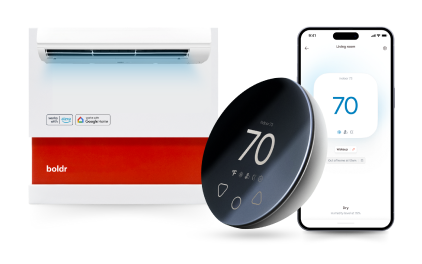
Klima - Smart Home Controller for Mini-splits, Air Conditioners and Heatpumps
Compatible with all brands of ACs and Mini-Splits Automate Climate Management Control remotely Reduce Energy Consumption Monitor bills in realtime
Try NowRecent Articles

Mini-Split Outdoor Unit Clearance 2026 Guide
A mini-split outdoor unit needs air. Lots of it. The condenser pull...
Read More
What Happens if Your Mini-Split Is Too Small?
Most homeowner sizing advice focuses on oversized mini-splits. But ...
Read More
Does a Mini-Split Need a Manual J Load Calculation?
A 500-square-foot room does not automatically need a 12,000 BTU min...
Read More
Signs Your Mini-Split May Have a Refrigerant Leak
A mini-split does not normally “use up” refrigerant the way a car u...
Read More
Mini-Split Minimum Capacity: Why It Matters
When homeowners compare mini-splits, they normally look at the bigg...
Read More