






Auxiliary heat (also called backup heat or supplemental heat) refers to a secondary heating source that activates when the primary mini-split heat pump cannot maintain the indoor temperature setpoint — typically because outdoor temperatures have dropped below the heat pump's efficient operating range. Understanding when, why, and how auxiliary heat works helps you design a complete heating system and avoid cold nights when the heat pump alone is not enough.
Compatible with all brands of ACs and Mini-Splits
Automate Climate Management
Control remotely
Reduce Energy Consumption
Monitor bills in realtimeKlima - Smart Home Thermostat for Mini-splits, Air Conditioners and Heatpumps
When Is Auxiliary Heat Needed?
Auxiliary heat is needed when outdoor temperature drops below the heat pump's balance point — the temperature at which the heat pump's output equals the building's heat loss rate. Below this point, the heat pump is running at full capacity but cannot keep up with demand:
- Standard mini-split: Balance point typically 10–20°F (−7 to −12°C)
- Cold-climate mini-split (H2i, Aurora, LGRED°): Balance point typically 0 to −13°F (−18 to −25°C)
Below the balance point, auxiliary heat bridges the gap between what the heat pump delivers and what the building needs.
Types of Auxiliary Heat
| Type | How It Works | Best For | Efficiency |
|---|---|---|---|
| Electric resistance strips | Heating coils installed in air handler or concealed duct; activate automatically below setpoint | Whole-home systems with existing air handlers | COP 1.0 — expensive to run but only active a few hours per year |
| Retained gas furnace (dual-fuel) | Heat pump handles moderate cold; furnace takes over below a set temperature (e.g., 0°F) | Homes with existing gas furnace | Gas at 80–97% efficiency; cost-effective in low gas-price markets |
| Electric baseboard (room-specific) | Baseboards retained in bedrooms or remote rooms as backup for coldest nights | Homes with existing baseboard (Quebec, Atlantic Canada) | COP 1.0 — expensive per hour but used rarely |
| Wood or pellet stove | Manual supplemental heat; operates independently from the mini-split | Rural properties; homes with existing fireplace | Depends on fuel cost; environmentally variable |
How Dual-Fuel (Heat Pump + Gas) Systems Work
A dual-fuel system pairs a heat pump with a gas furnace and uses an intelligent thermostat to decide which system runs at any given outdoor temperature. Above the balance point (e.g., above 0°F), the heat pump is more efficient than the gas furnace — the thermostat uses the heat pump. Below the balance point (e.g., below 0°F), gas becomes more cost-effective — the thermostat switches to the furnace. The crossover point is called the "economic balance point" and is set by the installer based on local electricity and gas prices.
Stay cool and save more. Use code JONES15 to get 15% off your entire order—no strings attached.
Upgrade your comfort with a Klima today.
Frequently Asked Questions
Do I need auxiliary heat with a cold-climate mini-split?
For most of the US and southern Canada, no — a properly sized cold-climate mini-split rated to −25°C handles virtually all heating hours without backup. For regions that regularly experience temperatures below −25°C (Prairie provinces, northern Ontario, extreme northern US), a small backup source for the rare hours below the mini-split's rated minimum is standard in well-designed systems.
How much does auxiliary heat add to operating costs?
Very little in most climates — backup heat is only active during the coldest hours of the year, which represent a small fraction of total heating hours. In Montreal (a cold but not extreme climate), temperatures are below −25°C for perhaps 2–5% of winter hours. Running electric resistance backup for those hours adds an estimated $50–$150 to the annual heating bill — small relative to the overall savings from the heat pump.
Related reading:
→ Mini-Split Balance Point Temperature: What It Is
→ Can a Mini-Split Replace a Furnace? Honest Assessment
→ Do Mini-Splits Work in Cold Weather?


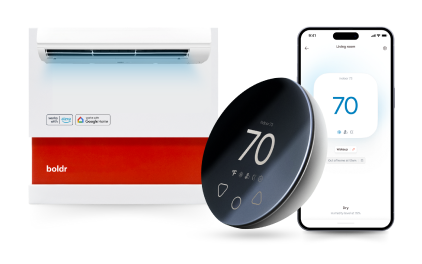
Klima - Smart Home Controller for Mini-splits, Air Conditioners and Heatpumps
Compatible with all brands of ACs and Mini-Splits Automate Climate Management Control remotely Reduce Energy Consumption Monitor bills in realtime
Try NowRecent Articles

Mini-Split Outdoor Unit Clearance 2026 Guide
A mini-split outdoor unit needs air. Lots of it. The condenser pull...
Read More
What Happens if Your Mini-Split Is Too Small?
Most homeowner sizing advice focuses on oversized mini-splits. But ...
Read More
Does a Mini-Split Need a Manual J Load Calculation?
A 500-square-foot room does not automatically need a 12,000 BTU min...
Read More
Signs Your Mini-Split May Have a Refrigerant Leak
A mini-split does not normally “use up” refrigerant the way a car u...
Read More
Mini-Split Minimum Capacity: Why It Matters
When homeowners compare mini-splits, they normally look at the bigg...
Read More