







Yes — mini-splits work in Canadian winters, but with an important qualification: it must be a cold-climate model rated to at least −25°C (−13°F), not a standard residential mini-split. Hundreds of thousands of Canadian homes now use cold-climate mini-splits as primary heat sources, including in Ontario, Quebec, Alberta, and BC. This article gives you an honest, practical answer to the question every Canadian homeowner asks before buying.
Compatible with all brands of ACs and Mini-Splits
Automate Climate Management
Control remotely
Reduce Energy Consumption
Monitor bills in realtimeKlima - Smart Home Thermostat for Mini-splits, Air Conditioners and Heatpumps
The Short Answer
Standard mini-splits do not work well in Canadian winters. Cold-climate mini-splits do — reliably, efficiently, and across the vast majority of Canadian temperature conditions experienced throughout the year.
What "Cold-Climate" Actually Means
Cold-climate mini-splits use enhanced vapour injection (EVI) or flash injection compressor technology to maintain useful heating output at outdoor temperatures down to −25°C (−13°F). At −15°C, a cold-climate model from Mitsubishi, Daikin, LG, or Fujitsu delivers approximately 80–90% of its rated BTU capacity. A standard mini-split at the same temperature delivers 40–60%.
Real-World Performance Across Canada
| Province / Region | Typical Winter Design Temp | Cold-Climate Mini-Split Performance |
|---|---|---|
| Metro Vancouver / Victoria | −5°C to −10°C | Excellent — well within rated range; high efficiency maintained |
| Southern Ontario / GTA | −15°C to −20°C | Very good — 75–90% capacity; reliable primary heat |
| Montreal / Southern Quebec | −20°C to −25°C | Good — 65–80% capacity; reliable with backup for extreme nights |
| Prairie provinces / Northern Ontario | −25°C to −35°C | Adequate for most hours; backup heat needed below −25°C |
| Northern Canada | Below −35°C common | Mini-split as supplement; primary heat source must be fossil fuel or wood |
What Happens Below −25°C
When outdoor temperatures drop below the unit's rated minimum (−25°C for most cold-climate models), the mini-split does not instantly fail — it typically reduces output significantly and may eventually shut down via its own protection logic. For regions that regularly experience temperatures below −25°C (much of Saskatchewan, Manitoba, northern Alberta, and northern Ontario/Quebec), a backup heating source for the hours below the mini-split's effective range is standard in properly designed systems.
The key point: even in Prairie winters, temperatures are below −25°C for a relatively small fraction of total winter hours. A cold-climate mini-split handles 85–90% of the heating season independently; backup covers the remaining 10–15%.
Defrost Cycles in Canadian Winters
In cold, humid weather, frost accumulates on the outdoor coil. The mini-split periodically runs a defrost cycle (3–10 minutes) to melt this frost before resuming heating. During defrost, the indoor unit may blow cooler air temporarily. This is normal and expected — it is not a fault. Defrost cycles are more frequent in very cold, humid conditions than in dry cold. Cold-climate models are designed with efficient defrost logic that minimises comfort interruption.
Frequently Asked Questions
Will a mini-split still work at −30°C?
Cold-climate models rated to −25°C may continue to operate at reduced capacity at −30°C, but they are not engineered or warranted for that operating condition. The Senville AURA series is specifically rated to −30°C (−22°F) and is marketed for extreme Canadian conditions. At −30°C, all cold-climate mini-splits should have reliable backup heat available.
What is the most popular cold-climate mini-split in Canada?
Mitsubishi's H2i (Hyper-Heating) series has the longest track record in the Canadian market and the most extensive certified installer network nationally. Daikin Aurora and LG LGRED° are also widely installed. The choice between them typically comes down to local installer availability and price — all three perform comparably at Canadian winter temperatures.
Related reading:
→ Best Mini-Splits for Canadian Winters: Works at −30°C
→ Do Mini-Splits Work in Cold Weather?
→ How Efficient Is a Mini-Split in Winter? Real Numbers


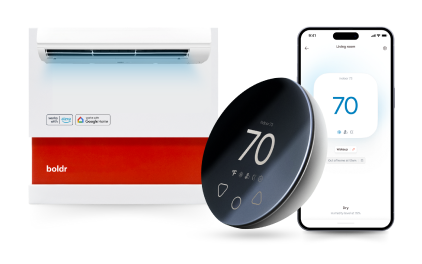
Klima - Smart Home Controller for Mini-splits, Air Conditioners and Heatpumps
Compatible with all brands of ACs and Mini-Splits Automate Climate Management Control remotely Reduce Energy Consumption Monitor bills in realtime
Try NowRecent Articles

Mini-Split Outdoor Unit Clearance 2026 Guide
A mini-split outdoor unit needs air. Lots of it. The condenser pull...
Read More
What Happens if Your Mini-Split Is Too Small?
Most homeowner sizing advice focuses on oversized mini-splits. But ...
Read More
Does a Mini-Split Need a Manual J Load Calculation?
A 500-square-foot room does not automatically need a 12,000 BTU min...
Read More
Signs Your Mini-Split May Have a Refrigerant Leak
A mini-split does not normally “use up” refrigerant the way a car u...
Read More
Mini-Split Minimum Capacity: Why It Matters
When homeowners compare mini-splits, they normally look at the bigg...
Read More