







Sizing a mini-split correctly means calculating the BTU output your room actually needs — not guessing based on a neighbour's setup or a salesperson's recommendation. An undersized unit will run constantly without reaching the desired temperature. An oversized unit will short-cycle, waste energy, and leave the room humid. This guide walks you through a practical BTU calculation for any room in your home.
Basic BTU Formula
The standard industry starting point is 20 BTU per square foot for a room with 8-foot ceilings, average insulation, and moderate climate. Multiply your room's square footage by 20 to get a baseline BTU number, then adjust for the factors below.
Example: A 400 sq ft living room × 20 = 8,000 BTU baseline → a 9,000 BTU mini-split is the closest standard size.
Quick BTU Reference by Room Size
| Room Size (sq ft) | Baseline BTU | Recommended Mini-Split |
|---|---|---|
| 100–200 | 2,000–4,000 | 6,000 BTU |
| 200–350 | 4,000–7,000 | 9,000 BTU |
| 350–500 | 7,000–10,000 | 12,000 BTU |
| 500–750 | 10,000–15,000 | 18,000 BTU |
| 750–1,000 | 15,000–20,000 | 24,000 BTU |
| 1,000–1,500 | 20,000–30,000 | 36,000 BTU or multi-zone |
Adjustment Factors
The baseline assumes standard conditions. Real rooms rarely match the baseline perfectly. Apply these adjustments to your calculation:
- Ceiling height: For 9-foot ceilings, add 12%. For 10-foot ceilings, add 25%. For vaulted or cathedral ceilings, add 30–40%.
- Sun exposure: Heavy direct sunlight through south- or west-facing windows: add 10–20%. Mostly shaded or north-facing: subtract 5–10%.
- Insulation: Well-insulated modern construction: use the baseline. Older homes with minimal insulation or single-pane windows: add 20–30%.
- Occupants: Each person beyond two adds roughly 600 BTU.
- Heat-generating equipment: Kitchens with gas stoves: add 2,000–4,000 BTU. Rooms with multiple computers: add based on total wattage.
- Climate zone (heating): If you plan to heat in a cold climate, the heating load is typically 20–40% higher than the cooling load. Always size to the larger number.
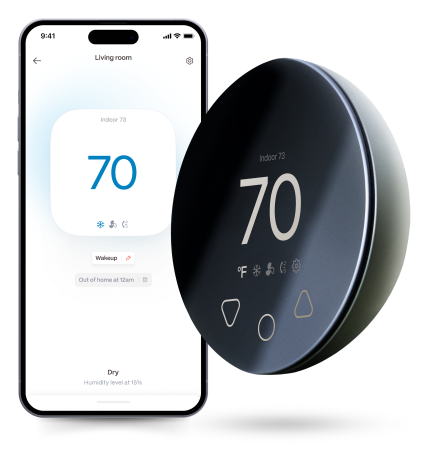
Compatible with all brands of ACs and Mini-Splits
Automate Climate Management
Control remotely
Reduce Energy Consumption
Monitor bills in realtimeKlima - Smart Home Thermostat for Mini-splits, Air Conditioners and Heatpumps
Step-by-Step Calculation Example
Room: 500 sq ft garage in Chicago, uninsulated, 10-foot ceilings, used as a workshop.
Step 1: Baseline → 500 × 20 = 10,000 BTU
Step 2: 10-foot ceilings → +25% → 12,500 BTU
Step 3: Uninsulated → +25% → 15,625 BTU
Step 4: Cold climate heating → +30% → 20,313 BTU
Step 5: Round to nearest standard size → 24,000 BTU
Common BTU Calculations by Room Type
| Room Type | Typical Size | Recommended BTU | Notes |
|---|---|---|---|
| Bedroom | 120–200 sq ft | 6,000 | Prioritize quiet operation |
| Living room | 300–500 sq ft | 9,000–12,000 | Multiple occupants; sun exposure |
| Master suite | 250–400 sq ft | 9,000–12,000 | Often includes attached bathroom |
| Home office | 100–200 sq ft | 6,000 | Add for computer heat load |
| 1-car garage | 200–300 sq ft | 9,000 | Add 25% if uninsulated |
| 2-car garage | 400–600 sq ft | 12,000–18,000 | Insulation makes a large difference |
| Basement | 500–1,000 sq ft | 12,000–24,000 | Below-grade stays cooler |
| Sunroom | 150–300 sq ft | 9,000–12,000 | High solar gain; add 15–20% |
Oversizing vs. Undersizing: Which Is Worse?
Oversizing is generally worse. An oversized mini-split cools the room quickly, then shuts off before dehumidifying properly. The result is a room that feels cold and clammy — especially problematic in humid climates like Florida, the Gulf Coast, or coastal British Columbia. The compressor also short-cycles, increasing wear and reducing its lifespan.
A slightly undersized unit (within 10% of the calculated need) will still work — it just runs at higher capacity more often and may not fully reach the setpoint on the most extreme days. If you are between sizes, sizing up one increment is usually the safer choice — but do not jump two sizes up.
When to Get a Professional Load Calculation
For single-room applications, the guidelines above are sufficient for most homeowners. For whole-home multi-zone systems, homes with unusual construction (log homes, passive houses, post-and-beam), or commercial applications, a professional Manual J load calculation is recommended. This is a room-by-room analysis performed by HVAC engineers using software that accounts for every variable. Most HVAC contractors offer Manual J calculations as part of the quoting process.
Frequently Asked Questions
What size mini-split do I need for 500 sq ft?
A 12,000 BTU (1-ton) unit is typically correct for 500 sq ft with standard 8-foot ceilings and average insulation. Adjust up for poor insulation, high ceilings, or heavy sun exposure.
Can I use one mini-split for two rooms?
A single indoor unit works best for one open room. If two rooms are connected by an open doorway and total under 500 sq ft, one unit can work. For separate closed rooms, you need separate indoor units.
Should I size for cooling or heating?
In warm climates, size for cooling. In cold climates (northern US, Canada), size for heating — the heating load is almost always higher. In mixed climates, calculate both and use the larger number.


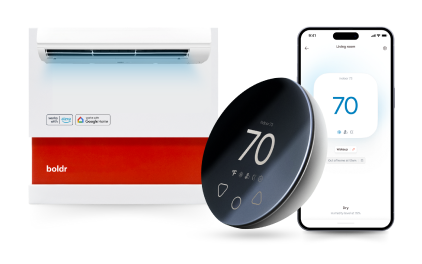
Klima - Smart Home Controller for Mini-splits, Air Conditioners and Heatpumps
Compatible with all brands of ACs and Mini-Splits Automate Climate Management Control remotely Reduce Energy Consumption Monitor bills in realtime
Try NowRecent Articles

Mini-Split Outdoor Unit Clearance 2026 Guide
A mini-split outdoor unit needs air. Lots of it. The condenser pull...
Read More
What Happens if Your Mini-Split Is Too Small?
Most homeowner sizing advice focuses on oversized mini-splits. But ...
Read More
Does a Mini-Split Need a Manual J Load Calculation?
A 500-square-foot room does not automatically need a 12,000 BTU min...
Read More
Signs Your Mini-Split May Have a Refrigerant Leak
A mini-split does not normally “use up” refrigerant the way a car u...
Read More
Mini-Split Minimum Capacity: Why It Matters
When homeowners compare mini-splits, they normally look at the bigg...
Read More