







Mini-split fan speed settings control how fast the indoor unit's blower fan runs — which affects how quickly conditioned air is distributed through the room, how loud the unit is, and how efficiently the coil transfers heat to or from the air. Most mini-splits offer 3–5 discrete fan speed settings plus an AUTO setting. Understanding what each does helps you get the most comfort and efficiency from your system.
Compatible with all brands of ACs and Mini-Splits
Automate Climate Management
Control remotely
Reduce Energy Consumption
Monitor bills in realtimeKlima - Smart Home Thermostat for Mini-splits, Air Conditioners and Heatpumps
Fan Speed Options Explained
| Setting | Typical Noise Level | Air Throw Distance | Best For |
|---|---|---|---|
| Low (1/Min) | 19–25 dB | Short — 6–10 ft | Sleeping, quiet environments, mild conditions |
| Medium (2–3) | 25–32 dB | Medium — 10–18 ft | Normal day-to-day use; most conditions |
| High (4–5/Max) | 35–45 dB | Long — 18–30 ft | Large rooms, rapid temperature recovery, very hot/cold days |
| Turbo / Powerful | 45–55 dB | Maximum | Rapid cooling or heating for 20–30 minutes; not for sustained use |
| Auto | Variable | Variable | Unit controls fan speed based on how far room temperature is from setpoint |
How AUTO Fan Speed Works
In AUTO fan speed mode, the mini-split varies fan speed based on how far the room temperature is from the setpoint. When there is a large temperature difference (e.g., setpoint is 68°F but room is 82°F), the fan runs at high speed to move more conditioned air. As the room approaches setpoint, the fan slows down to maintain temperature quietly. AUTO is generally the most efficient setting for sustained operation.
Fan Speed and Dehumidification
A lower fan speed improves dehumidification — the air spends more time in contact with the cold evaporator coil, giving moisture more time to condense out of the air. If humidity is a concern (especially in coastal or basement environments), running at medium or low fan speed rather than high removes more moisture per hour of runtime. This is also why dry mode uses a fixed low fan speed.
Frequently Asked Questions
What fan speed is most efficient?
AUTO fan speed is typically the most efficient for sustained operation because it matches airflow to the actual demand. Medium speed is a good manual choice for most conditions — it balances noise, air throw, and dehumidification. High fan speed moves more air quickly but removes less humidity per unit of runtime.
Should I run the fan continuously?
Mini-split fan-only mode (running the fan without the compressor) can help circulate air and even out room temperatures, but it does not actively heat or cool. Some people run fan-only mode at low speed to maintain gentle air circulation when the room is near setpoint. This uses very little electricity (15–30 watts for the fan motor only).
Why does my mini-split fan run even when the room has reached setpoint?
Most mini-splits continue running the indoor fan at low speed even after the compressor shuts off — this distributes any residual cold or warm air from the coil and prevents moisture from accumulating on the evaporator. This is normal behaviour and not a fault.
Related reading:
→ Mini-Split Auto Mode Explained: What Does It Actually Do?
→ Mini-Split Dry Mode vs Cool Mode: What's the Difference?
→ Mini-Split Making Noise: What Each Sound Means


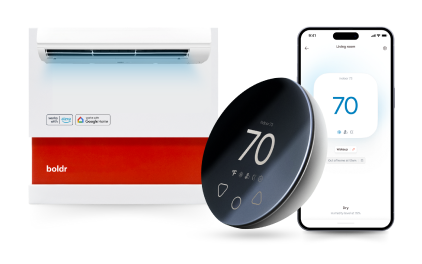
Klima - Smart Home Controller for Mini-splits, Air Conditioners and Heatpumps
Compatible with all brands of ACs and Mini-Splits Automate Climate Management Control remotely Reduce Energy Consumption Monitor bills in realtime
Try NowRecent Articles

Mini-Split Outdoor Unit Clearance 2026 Guide
A mini-split outdoor unit needs air. Lots of it. The condenser pull...
Read More
What Happens if Your Mini-Split Is Too Small?
Most homeowner sizing advice focuses on oversized mini-splits. But ...
Read More
Does a Mini-Split Need a Manual J Load Calculation?
A 500-square-foot room does not automatically need a 12,000 BTU min...
Read More
Signs Your Mini-Split May Have a Refrigerant Leak
A mini-split does not normally “use up” refrigerant the way a car u...
Read More
Mini-Split Minimum Capacity: Why It Matters
When homeowners compare mini-splits, they normally look at the bigg...
Read More