







A detached garage presents specific HVAC challenges compared to an attached garage — it has no connection to the home's electrical panel (requiring a sub-panel), is often more exposed on all four sides, may have worse insulation, and the line set must span the distance between structures. This guide covers the complete approach to installing a mini-split in a detached garage, including the sub-panel requirement, sizing for the exposure, and the best models for year-round use.
Compatible with all brands of ACs and Mini-Splits
Automate Climate Management
Control remotely
Reduce Energy Consumption
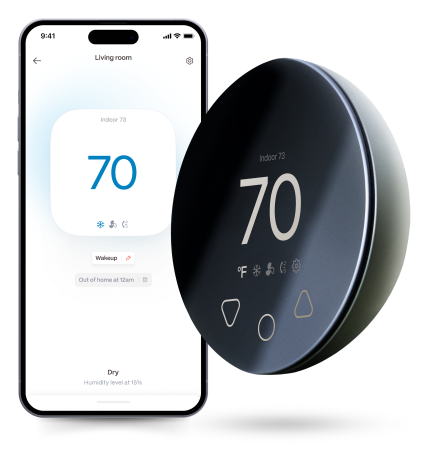
Monitor bills in realtimeKlima - Smart Home Thermostat for Mini-splits, Air Conditioners and Heatpumps
How a Detached Garage Installation Differs
| Factor | Attached Garage | Detached Garage |
|---|---|---|
| Electrical supply | Run circuit from main panel | Sub-panel in garage fed from main house — additional cost |
| Thermal exposure | One wall shared with house | All four walls exposed — higher heat loss and gain |
| Line set routing | Through wall directly | Through wall + across yard underground or overhead (code-compliant) |
| Maximum line set length | Typically 15–50 ft | Can reach 100+ ft if garage is far from house — check model's max |
The Sub-Panel Requirement
A detached garage mini-split requires its own dedicated 240V circuit. In a detached structure, this circuit must be fed from a sub-panel installed in the garage, which in turn is fed from the main house panel. Key points:
- A licensed electrician must run the underground feed from the main panel to the garage sub-panel — this must meet burial depth requirements (typically 24 inches for rigid conduit, 12–24 inches for underground feeder cable depending on jurisdiction)
- Sub-panel installation adds CAD $1,500–$4,000 / USD $1,200–$3,500 to the project cost if one does not already exist
- If a sub-panel already exists in the garage, a dedicated mini-split circuit can be added for CAD $400–$800 / USD $300–$700
Sizing for a Detached Garage
| Garage Size | Insulation | Recommended BTU |
|---|---|---|
| Single car (200–250 sq ft) | Insulated walls + door | 12,000–18,000 BTU |
| Two car (400–500 sq ft) | Insulated walls + door | 18,000–24,000 BTU |
| Two car (400–500 sq ft) | Uninsulated or minimal | 24,000–36,000 BTU |
Size 20–30% larger than you would for equivalent square footage inside the house — the four-sided exposure in a detached structure increases heat loss and gain significantly compared to an attached garage with a shared house wall.
Line Set Length Considerations
Most residential mini-splits support line set runs of 25–75 feet without refrigerant charge adjustment. For longer runs (75–150 ft), additional refrigerant must be added at installation — a licensed HVAC technician calculates the additional charge based on the extra line set length. Confirm your chosen model's maximum line set length before purchasing — exceeding it requires a commercial-grade system.
Frequently Asked Questions
Can I run a mini-split line set underground between the house and garage?
Yes — underground line set runs are common for detached garages. The refrigerant lines must be properly insulated and enclosed in conduit meeting local burial depth requirements. The installation is more complex and expensive than an above-ground run, but results in a cleaner installation. Your HVAC installer will advise on the best routing option for your specific property layout.
Related reading:
→ Mini-Split for Garage: Sizing, Cost and Best Picks
→ Mini-Split Breaker Size: What Circuit Does Each Unit Need?
→ How Long Does Mini-Split Installation Take?


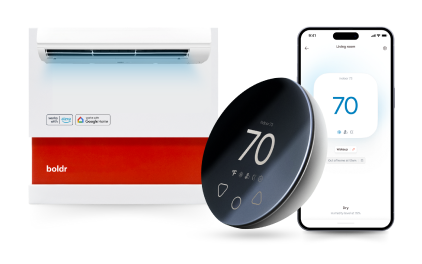
Klima - Smart Home Controller for Mini-splits, Air Conditioners and Heatpumps
Compatible with all brands of ACs and Mini-Splits Automate Climate Management Control remotely Reduce Energy Consumption Monitor bills in realtime
Try NowRecent Articles

Can You Install a Mini-Split in a Laundry Room?
A laundry room can become one of the hottest and most humid spaces ...
Read More
Mini-Splits in Rooms With Vaulted Ceilings
A room with a vaulted ceiling cannot be sized or controlled in the ...
Read More
Using a Mini-Split With a Wood Stove or Fireplace in 2026
A mini-split and wood-burning appliance can work together, but the ...
Read More
Repair or Replace Your Mini-Split? A Practical 2026 Guide
A failed mini-split does not always need to be replaced. A blocked ...
Read More
Mini-Split for 2-Car Garage: Sizing and Best Options
A two-car garage is one of the most common spaces where homeowners ...
Read More