







Installing a mini-split to heat and cool a finished attic space is one of the most effective solutions to a notoriously difficult HVAC challenge — attics are hot in summer, cold in winter, and often unreachable by the main home's ductwork. A mini-split solves all three problems independently. This guide covers the specific considerations for attic installations, including placement, sizing, condensate management, and whether a wall-mount or ceiling cassette suits your space better.
Compatible with all brands of ACs and Mini-Splits
Automate Climate Management
Control remotely
Reduce Energy Consumption
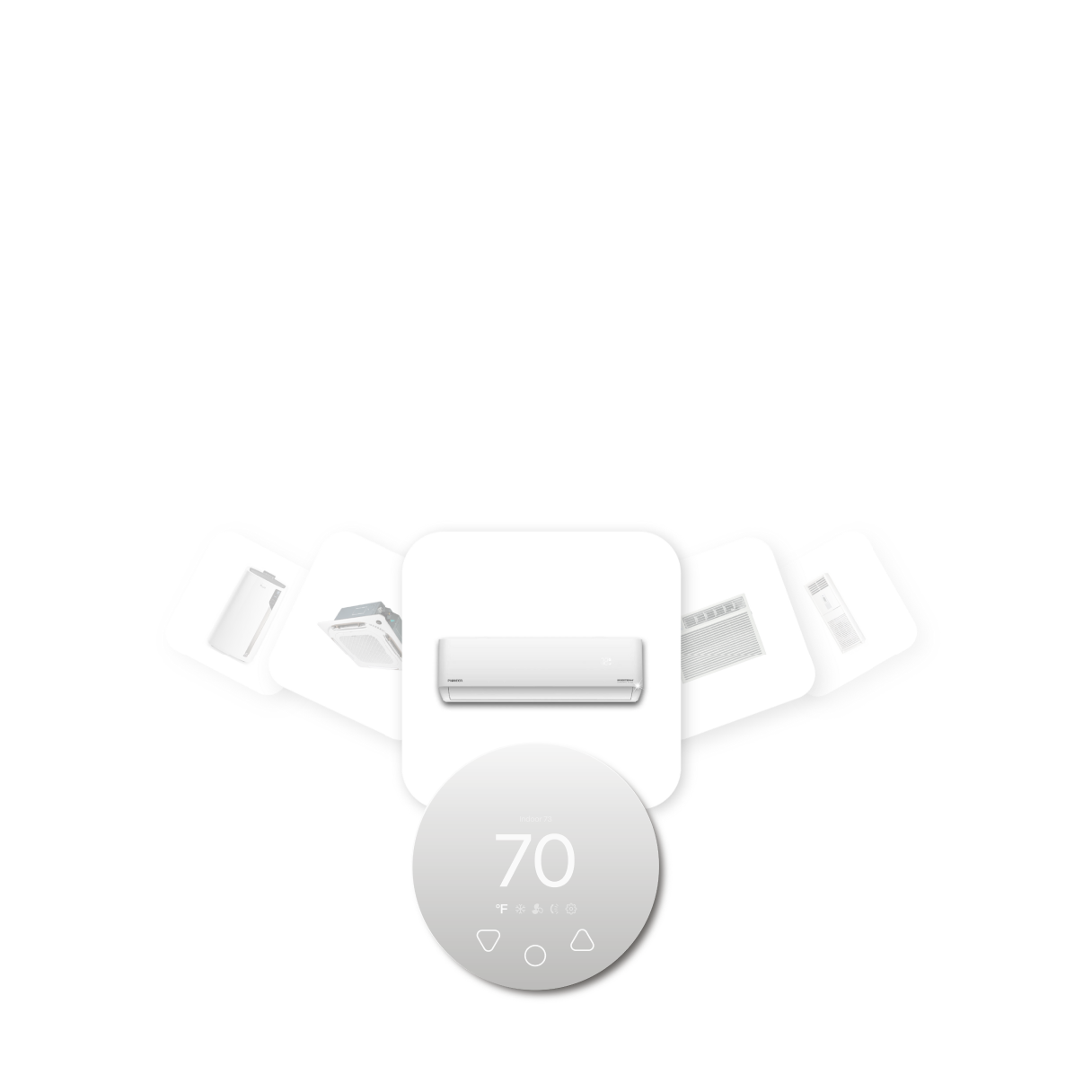
Monitor bills in realtimeKlima - Smart Home Thermostat for Mini-splits, Air Conditioners and Heatpumps

Why Attics Are Difficult to Condition
- Extreme temperature swings: An uninsulated attic can reach 60°C (140°F) in summer and −20°C in winter in cold climates — far beyond the comfortable range
- Poor insulation: Sloped ceiling surfaces have limited insulation depth compared to flat ceiling applications
- No existing ductwork: Attics are almost always outside the home's duct system — adding ductwork through a finished attic is expensive and disruptive
- Limited wall space: Sloped walls limit where a wall-mount indoor unit can be positioned to achieve good airflow distribution
Sizing for Finished Attic Spaces
| Attic Size (Finished) | Insulation | Recommended BTU |
|---|---|---|
| Under 300 sq ft | Good (R-30+) | 9,000–12,000 BTU |
| 300–500 sq ft | Good (R-30+) | 12,000–18,000 BTU |
| 300–500 sq ft | Minimal or poor | 18,000–24,000 BTU |
| 500+ sq ft | Any | 24,000 BTU or 2 units |
Size up generously for attic spaces — the extreme summer heat loads and cold-climate exposure make attic HVAC more demanding than standard rooms at the same square footage.
Unit Type: Wall-Mount vs Ceiling Cassette
Wall-mount: Works well in attics with vertical knee walls — mount high on the knee wall and the unit distributes air across the floor area. This is the most common and least expensive option.
Ceiling cassette: Ideal for open-plan attic spaces with flat or nearly flat ceiling sections — the cassette sits flush in the ceiling and distributes air in four directions. Requires ceiling cavity depth for installation.
Condensate Management in Attics
Condensate drainage is the critical attic installation challenge. The indoor unit produces condensate that must drain away from the unit. In an attic, gravity drainage to a lower floor or exterior is often possible but requires careful routing of the drain line. If gravity drainage is not feasible, a condensate pump is required — a small electric pump that lifts condensate to a drain point. Never allow condensate to pool in the attic; water damage to the structure below is the result.
Frequently Asked Questions
Do I need to insulate the attic before installing a mini-split?
Insulating before installing is strongly recommended. An uninsulated finished attic requires a significantly larger mini-split and costs far more to operate. Spray foam insulation on the roof deck (inside) is the most effective solution for finished attic spaces — it converts the attic thermal envelope and dramatically reduces the HVAC load. The combination of proper insulation plus a correctly sized mini-split produces the best comfort and lowest operating cost.
Can the outdoor unit be located in the attic?
No — the outdoor unit must be located outside with free airflow and clearance on all sides. It cannot be installed in an enclosed attic space. The line set runs from the indoor unit through the attic structure to an exterior wall or roof penetration and down to the outdoor unit mounted outside the building.
Related reading:
→ Mini-Split Installation Guide: The Complete Process
→ Mini-Split Ceiling Cassette vs Wall Mount: Which to Choose?
→ Mini-Split for Home Addition vs Extending Ductwork



Klima - Smart Home Controller for Mini-splits, Air Conditioners and Heatpumps
Compatible with all brands of ACs and Mini-Splits Automate Climate Management Control remotely Reduce Energy Consumption Monitor bills in realtime
Try NowRecent Articles

Mini-Split Outdoor Unit Clearance 2026 Guide
A mini-split outdoor unit needs air. Lots of it. The condenser pull...
Read More
What Happens if Your Mini-Split Is Too Small?
Most homeowner sizing advice focuses on oversized mini-splits. But ...
Read More
Does a Mini-Split Need a Manual J Load Calculation?
A 500-square-foot room does not automatically need a 12,000 BTU min...
Read More
Signs Your Mini-Split May Have a Refrigerant Leak
A mini-split does not normally “use up” refrigerant the way a car u...
Read More
Mini-Split Minimum Capacity: Why It Matters
When homeowners compare mini-splits, they normally look at the bigg...
Read More