







A sunporch, sunroom, or three-season room is one of the most rewarding — and most thermally challenging — spaces to condition with a mini-split. Glass-heavy construction means extreme solar heat gain in summer and significant heat loss in winter. With the right sizing and a cold-climate model where needed, a mini-split transforms a barely-usable seasonal space into a comfortable year-round living area. This guide covers everything specific to sunporch installations.
Compatible with all brands of ACs and Mini-Splits
Automate Climate Management
Control remotely
Reduce Energy Consumption
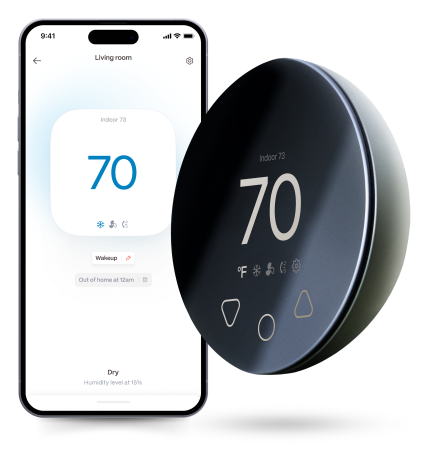
Monitor bills in realtimeKlima - Smart Home Thermostat for Mini-splits, Air Conditioners and Heatpumps
Why Sunporches Are Different from Standard Rooms
A sunporch or sunroom typically has 40–70% glass coverage compared to 15–20% in a standard room. This fundamentally changes the heat load:
- Summer solar gain: Direct sun through large glass surfaces can add 2,000–6,000 BTU/hr of heat load per hour of peak sun, depending on glass area and orientation
- Winter heat loss: Even double-glazed glass has an R-value of only 2–4 compared to an insulated wall at R-13 to R-20 — sunporches lose heat far faster than standard rooms
- Temperature swings: The thermal mass is low — a sunporch cools and heats quickly as outdoor conditions change
Sizing a Mini-Split for a Sunporch
| Sunporch Size | Glass Coverage | Orientation | Recommended BTU |
|---|---|---|---|
| Under 150 sq ft | Moderate (3 sides) | North or east | 9,000–12,000 BTU |
| Under 150 sq ft | Heavy (3–4 sides) | South or west | 12,000–18,000 BTU |
| 150–300 sq ft | Moderate | Any | 12,000–18,000 BTU |
| 150–300 sq ft | Heavy | South or west | 18,000–24,000 BTU |
Rule of thumb for sunporches: size 50–75% larger than you would for the same square footage of standard interior space.
Cold-Climate Sunporches
For a sunporch used in spring and fall (or year-round) in Canada or the northern US, a cold-climate mini-split is essential. Single-glazed or older double-glazed sunporches in cold climates lose heat extremely rapidly at low temperatures — a standard mini-split struggling to heat through −10°C outdoor air loses efficiency at exactly the moment a sunporch needs the most heat. Cold-climate models maintain full or near-full output at the temperatures that matter most for shoulder-season sunporch comfort.
Placement Tips for Sunporch Indoor Units
- Mount the indoor unit on the interior wall (the wall connecting to the house) rather than an exterior glass wall — this keeps it away from the most extreme temperature surfaces and positions it to draw cooler/warmer house air for better temperature averaging
- Angle the louvres to direct conditioned air toward the glass surfaces — this counteracts the solar gain in summer and the heat loss in winter at the source
- For very large sunporches with multiple glass walls, consider two smaller units (one on each side) rather than one large unit to ensure even distribution
Frequently Asked Questions
Can a mini-split keep a sunporch comfortable during a Canadian summer?
Yes — with correct sizing. A south-facing sunporch on a hot summer day can have an effective heat load of 30–40 BTU/sq ft or more during peak sun hours. A properly sized mini-split handles this load, but an undersized unit will run continuously at maximum output and still fail to cool the space. When in doubt for a glass-heavy space, size up rather than down.
Related reading:
→ Mini-Split Sizing Guide: How to Choose the Right BTU
→ Mini-Split for Sunroom: What Size and Which Unit?
→ Best Mini-Split for Cold Climate 2026


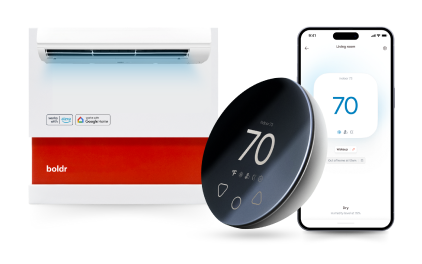
Klima - Smart Home Controller for Mini-splits, Air Conditioners and Heatpumps
Compatible with all brands of ACs and Mini-Splits Automate Climate Management Control remotely Reduce Energy Consumption Monitor bills in realtime
Try NowRecent Articles

Mini-Split Outdoor Unit Clearance 2026 Guide
A mini-split outdoor unit needs air. Lots of it. The condenser pull...
Read More
What Happens if Your Mini-Split Is Too Small?
Most homeowner sizing advice focuses on oversized mini-splits. But ...
Read More
Does a Mini-Split Need a Manual J Load Calculation?
A 500-square-foot room does not automatically need a 12,000 BTU min...
Read More
Signs Your Mini-Split May Have a Refrigerant Leak
A mini-split does not normally “use up” refrigerant the way a car u...
Read More
Mini-Split Minimum Capacity: Why It Matters
When homeowners compare mini-splits, they normally look at the bigg...
Read More